
Showing posts with label YearofFaith. Show all posts
Showing posts with label YearofFaith. Show all posts
Mar 5, 2013
Jan 10, 2013
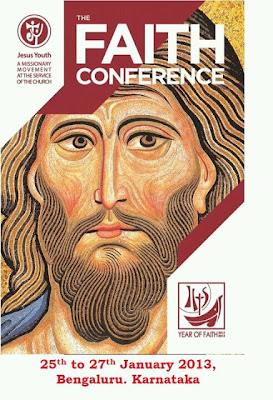
Karnataka Faith Conference 2013
Dear All,
Prayer filled greetings from Jesus Youth Karnataka!
At the onset we wish you God’s choicest blessings upon you and your family.
For us Jesus Youth, the Jubilee was a time of special grace for everyone in the movement, during the course of which there were numerous occasions to reflect on the call and mission of being a Jesus Youth. The declaration of the Year of Faith has been most eagerly welcomed in the Jesus Youth movement as a God-given opportunity for ‘fostering the graces received during the Jubilee’.
In this context, Jesus Youth is initiating a series of regional conferences titled “Faith Conference 2013” across the country, with the central theme “Faith’. The conference in the region of Karnataka will be held from the 25th (8:30am) to 27th of January, 2013 (5:00pm) at the Apostolic Carmel Generalate (behind Sagar Hospital on Banerghata Road), Bangalore. This 3 day Conference will be based on the theme "Know the Faith", "Live the Faith" and "Share the Faith".
Accompanying youth on their journey of faith has been the favored mission of the Jesus Youth movement and this conference would enable the participants to know more and re-discover their Faith. Around 800 to 1000 Jesus Youth from across Karnataka are expected to participate in this conference.
It is with much thirst and dreams for the Lord that we host this program in Bangalore. The program is organized in three streams – for youth in English, for youth in Kannada and for families. We have even organized a Kids Care centre to take care of the children during the Conference days.
With great happiness, we invite you all to come and be a part of this Conference and share with us the blessings from above.
For more details on registration, please contact:
John Joseph (+91-9980092105)

Dec 5, 2012

Overview of Second Vatican Council - Part 3
CHANGES
What were some of the changes
that the Council brought about? Many of our attitudes, many of the things that
today we take for granted, came about as a consequence of Vatican 2. There are
far, far too many things that could be mentioned – and here are just a few.
1. The Church itself -
Vatican 2 redefined, re-imaged the Church
 Since the break-up of
Christendom at the time of the Reformation ( 400 years earlier ) the Catholic
Church had become very inward looking, had become reactionary and had withdrawn
itself from the world. It had seen itself, referred to itself, as a ‘perfect
society’. In reacting to what had happened at the Reformation, it had become a
fortress Church – withdrawn, pulled up draw bridges, isolated.
Since the break-up of
Christendom at the time of the Reformation ( 400 years earlier ) the Catholic
Church had become very inward looking, had become reactionary and had withdrawn
itself from the world. It had seen itself, referred to itself, as a ‘perfect
society’. In reacting to what had happened at the Reformation, it had become a
fortress Church – withdrawn, pulled up draw bridges, isolated.
The Council pushed the Church
back into the world. It used ancient biblical images to redefine the Church –
People of God, the Body of Christ, the Edifice of God, the sheepfold, the
community of believers. Instead of portraying the Church as a perfect society,
it redefined the Church as a community of those believers who are on a
pilgrimage, sharing ‘the joys, the hopes and the anxieties’ of humankind.
The Council said that the
Church was the People of God – it was a community of all the baptised, both
laity and their pastors. “The Church is a priestly people, it is like a pilgrim
in a foreign land, and it presses forward amid the persecutions of the world,
announcing the cross and death of the Lord until he comes.”
2. Laity
 If you re-image an organisation
– you end up redefining those who make up the organisation. So we saw in
Vatican 2 a new place for the laity. The Church was to be less clerical. All
are equal members by Christian Baptism. Roles may differ, but Baptism is the
key sacrament and makes all of us members of the Church. “All are called to be
holy.” Prior to the Council if you wanted to be holy you left the world, you
became a priest or entered a religious order. All can be holy in the world.
If you re-image an organisation
– you end up redefining those who make up the organisation. So we saw in
Vatican 2 a new place for the laity. The Church was to be less clerical. All
are equal members by Christian Baptism. Roles may differ, but Baptism is the
key sacrament and makes all of us members of the Church. “All are called to be
holy.” Prior to the Council if you wanted to be holy you left the world, you
became a priest or entered a religious order. All can be holy in the world.
The role of women has changed.
They are regarded as equal with men in the lay state. Women today however
challenge the Church towards continuing progress and development. We have seen
much more lay involvement in the Church. The laity are key to the Church’s
mission, because they live in the heart of the modern world and work in its
engine rooms. 99% of the Church is made up of lay people.
Since the Council there is a
huge increase in ministries in the Church. Council reminded us that ministry is
rooted in Baptism not Holy Orders. Today the laity is absolutely vital to every
enterprise of the Church.
3. Liturgy
 Perhaps the most obvious change
of all came about in regard to the way in which the Church goes about worship.
Prior to the Council, most saw the liturgy as the domain of the clergy or the
priest. Over time, the liturgy had become clericalised. The laity had become
passive spectators saying their prayers and devotions. The Council decreed in
that famous text, that in regard to its worship, the Church desired nothing
less ‘than the full, active and conscious participation of the faithful’. The
Council ordered a complete revision of the way that all of the sacraments were
celebrated. As a consequence – in 1970 – we finally got a whole new way of
celebrating the Eucharist.
Perhaps the most obvious change
of all came about in regard to the way in which the Church goes about worship.
Prior to the Council, most saw the liturgy as the domain of the clergy or the
priest. Over time, the liturgy had become clericalised. The laity had become
passive spectators saying their prayers and devotions. The Council decreed in
that famous text, that in regard to its worship, the Church desired nothing
less ‘than the full, active and conscious participation of the faithful’. The
Council ordered a complete revision of the way that all of the sacraments were
celebrated. As a consequence – in 1970 – we finally got a whole new way of
celebrating the Eucharist.
We can recall how altars were
turned to face the people, and Latin was replaced with local language. At the
time many thought that these were brand new ideas. They weren’t new at all. The
Church was just going back to an earlier tradition of how it conducted the
liturgy. Our liturgy today is a lot less clerical, for we now understand that
liturgy is essentially the work of the people.
4. Ecumenism
 One area in which the Council
brought about great change was in its understanding and relationship with other
Churches. Prior to the Council it was hoped that Protestants would return to
the ‘one, true Church’ and that the Orthodox schism would end. In the decades
before the Council, Protestants had become more and more involved in what had
come to be called the ‘Ecumenical Movement’. The World Council of Churches had
been founded and there had been many mergers of churches. All of these moves
expressed a hope for unity among the Christian Churches. But the Roman Catholic
Church remained aloof from all of this.
One area in which the Council
brought about great change was in its understanding and relationship with other
Churches. Prior to the Council it was hoped that Protestants would return to
the ‘one, true Church’ and that the Orthodox schism would end. In the decades
before the Council, Protestants had become more and more involved in what had
come to be called the ‘Ecumenical Movement’. The World Council of Churches had
been founded and there had been many mergers of churches. All of these moves
expressed a hope for unity among the Christian Churches. But the Roman Catholic
Church remained aloof from all of this.
And then came Pope John who
called his Ecumenical Council. He immediately set about inviting the separated
communities to send delegations. He showed how important they were by insisting
that they be seated in the front of St Peter’s just across the aisle from the
patriarchs and cardinals. Until Vatican 2, we as Catholics didn’t recognise the
other Christian Churches. We saw them as heretics and schismatics. At Vatican 2
we recognised the validity of their Baptism and the Council demanded that we
look upon these communities as ecclesial, and that the members of these
churches were indeed ‘our brothers and sisters in Christ’. A revolution!
When Pope Paul VI took over the
Council after John’s death, he spent a great deal of time in his opening speech
at the Council’s second session on the subject of Christian unity. Christ
willed and desired that his Church be one. The ecumenical movement and the
desire for Christian unity continue to our own time. It is a work in progress.
We must, as Christians, pray and work that all who believe in Jesus may be one.
Material compiled by
Monsignor Paul Farmer of the Auckland Diocese
Nov 28, 2012
Overview of Second Vatican Council - Part 2

THE COUNCIL BEGINS
The following is an excerpt from an author giving an account
of the Council’s grand opening ceremony in Rome: Pope John was 81 years of age
when, on a marvellous October morning in 1962, he was carried on his sedia
gestatoria into St Peter’s. His face was wet with tears. Never had the papacy
been so high in public esteem. If all popes were like him, it was said,
everyone would be lining up to be a Catholic. He personified the phrase of
Horace, ‘Nothing prevents one from telling the truth with a smile on one’s
face.’ The Council showed that even a pope was prepared to listen and learn.
In his opening address, he made it plain that the Church was
not to heed the prophets of doom. The Church had to update herself radically,
and without fear. The cold war of the churches, as far as Rome was concerned
was over. There were to be no anathemas; instead, a return to the Gospel of the
Master, Jesus Christ. The presence of non-Catholic observers in the aula was a
sign of the Church’s change of heart.
The historian McBrien says of Pope John. ‘In a period of
less than 5 years he almost single-handedly transformed the Catholic Church
from a clericalistic, monarchical, unecumenical and theologically rigid body to
a community of radical equality in Christ – laity, religious and clergy alike,
open to dialogue and collaboration with other Christian and non-Christian
communities with non-believers, and with the world at large.’
And there’s another beautiful story told of this
ever-so-human pope. It’s a story that you still hear in Rome and that you read
over and over in any writing about this man. It goes, that on the night of
October 11, 1962, the night of the opening of the Second Vatican Council,
something like half a million people gathered in St Peter’s Square below the Pope’s
bedroom window. The crowd chanted and sang. The aim was to bring Pope John to
his window. And on the night of the greatest day of his life, he rewarded their
singing and chanting by appearing at his window. He called out to them,
“Children, I hear your voices,” and then he went on to explain to this mixed
gathering his hopes for the Council. One historian I read says that the event
was very well recorded in the Roman papers the next day and from that moment
the skeptical Romans were totally converted to his Council. When he
finished his explanation of the Council, he said to the crowd. “Now go back
home, and give your little children a kiss – and tell them it’s from Pope
John.” As one commentator put it: “You could almost touch the emotion. The ‘patriarch’
gave and generated love with all his being.”
At the time of its opening session, Pope John was a sick
man, with cancer. He died on 3rd June the following year, as a never-before
worldwide audience prayed and journeyed with him in his final days. He had
become universally loved like no pope before him.

Pope Paul VI
He was succeeded by that most Catholic of popes, Paul VI,
who was totally committed to the vision of his predecessor. For the next three
years he led the Council to its climax and conclusion in December 1965.
To be continued.......
Material compiled by Monsignor Paul Farmer of the Auckland
Diocese
Nov 20, 2012
Overview of Second Vatican Council - Part 1

On 11 October 2012 – our Church celebrated the 50th anniversary of the opening of the Second Vatican Council. It would be a great pity if such an anniversary were to pass us by without comment or reflection on why the Council was convened, and what it achieved.
The Second Vatican Council was a huge event in Catholic life. Many have referred to it over the decades as a tsunami. It certainly was, in the sense that it changed and altered Catholic life in a dramatic way.

Pope John XXIII (now Blessed John XXIII) the initiator of the Council, preferred to call the Council “a new Pentecost”. It was his dearest hope that the Council would be a new springtime in the life of the Church. The Council was presided over by two outstanding Church leaders- Pope John XXIII and Pope Paul VI. John had been pope for less than ninety days when, even to the surprise of those closest to him, he called the Church into Council. The last General Council of the Church had been held in 1870. Pope John realised that the world of the sixties was indeed a very different world.
Let us dwell for a few moments on Pope John because he was by all accounts an extraordinary person. John XIII enjoyed a short pontificate, and his decision to call a Council was responsible for initiating a period of change in our Church that continues to this day.
Whatever author you read in regard to Pope John, he was
obviously a man who trusted deeply in God. He was a charismatic man, a man of
simplicity and humour and shrewd wisdom. His only wish was to draw people to God. He continually
reached out to all – both those within the Church and beyond, with a message of
peace, renewal and reconciliation. His vision was to bring the Church back to the gospel of Jesus Christ As one author puts
it … “he was that rare phenomenon; a charistmatic Christian in a hierarchical
position.” What he did, was what he was! John XXIII knew the
inevitability of change & development. He was an historian by training, and
history had taught him - as it can teach us - that nothing is unalterable. Pope John’s profound faith in God, his great love for the
Church and for all humanity, together with his historical perspective, led him
to change the course of the Catholic Church irreversibly. Good Pope John - as he was affectionately known and is still
called - desired that his Council would have wide aspirations and that it would
be pastoral. It would not be a Council that condemned. John saw himself
essentially as a pastor, as a shepherd, who wanted to bring everyone with his
embrace.
To be continued.......
Material compiled by Monsignor Paul Farmer of the Auckland
Diocese
Subscribe to:
Posts (Atom)